1



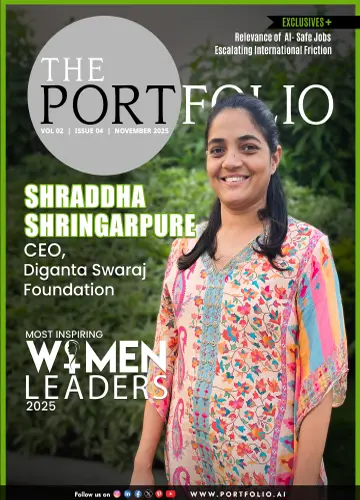
Shraddha Shringarpure - Most Inspiring Women Leaders 2025
Left Mumbai at 22 to co-found Diganta Swaraj and to turn drought-hit tribal villages into water-surplus areas with 90 bunds storing 100 crore litres. With fearless empathy and community ownership, Shraddha Shringarpure ended child marriages, revived education for 5,000 dropouts, and proved rural women can lead lasting change.
In the sun-scorched hills of Mokhada, where rains vanish into cracked earth and women walk miles for a pot of water, a quiet revolution is taking shape. At 22, Shraddha Shringarpure left the bustling city of Mumbai to live among tribal communities where girls’ dreams are often cut short by early marriage and opportunity is scarce. Guided by the legacy of her freedom-fighter grandparents, she turned determination into action, building water bunds, schools, and futures where they were most needed. Together with her husband, Rahul Tiwrekar, she co-founded the Diganta Swaraj Foundation, an organization addressing child marriage, water scarcity, education gaps, and women’s empowerment. Under their leadership, DSF has made ten villages water selfsufficient, constructed 90 cement nala bunds storing over 100 crore litres of water, planted more than 500,000 trees supporting nearly 2,000 farmers, and reintegrated over 5,000 school dropouts. Shraddha’s work has been recognized with awards such as the Yashwantrao Chavan Pratishtan Award and the Dr. Ram Manohar Tripathi Lok Seva Samman. During this exclusive interaction with Portfolio Magazine, she shares her vision, mission, and plans in detail, offering insights into how passion, perseverance, and purpose can transform the driest lands into hubs of opportunity and empowerment.
During my Master’s in Social Work at Nirmala Niketan, I was offered a placement in Mokhada, a remote tribal area in Thane. My childhood wasn’t easy, but financially insecure. I started earning money from the age of 10, teaching, managing shops, and working in a hotel. Those experiences made me resilient and observant. My freedom-fighter grandfather instilled a legacy of service. Professor Avinash Kohle recognised my passion for public issues and guided me toward an MSW. There, I met homeless children begging, without families and my problems felt small. Later in Mokhada, a tribal block in Palghar District , I saw stark poverty: no food, no transport, forced migration, malnourished babies, and girls marrying at 13. I knew I had to act. Convincing my parents was tough; as their only child, they feared that the place had no electricity or phone signals. Their bold yes was crucial. Settling in was adventurous as there were no buses after 6 pm, and weeks without power. We’d hold village meetings by the light of vehicle headlights. I saw a woman’s challenge about water scarcity, which involved a nearly dry well where she risked her life for a pot of water. It shifted my focus to real solutions, such as integrated village development that combines water, agriculture, and markets. “You can’t define poverty in books. It’s the hunger in someone’s belly, the struggle to catch a bus, the desperate journey people must take just to survive”
Unlearning city ways was the biggest shift I had to make. Mumbai bred urgency; tribals taught patience and resilience. From a tough childhood, I could’ve chosen a career in corporate security, but my mother and grandfather shaped me to put others first. His freedomfighting spirit, standing for the nation with nothing, taught me that people come before self. “Letting go of perfection and embracing the unfolding process has been my biggest internal transformation.”
The National Family Health Survey shows 7.9% of women aged 15-19 in Maharashtra are mothers or pregnant, trapped by child marriage or unwed motherhood due to low reproductive health awareness. Early marriage risks lives. We engaged gram panchayats to pass resolutions banning it. Girls debate parents in Gram sabhas, sharing education dreams. Our animators highlight opportunities. The community owns the change; our ‘prerikas’, girl leaders, have become elected representatives, amplifying adolescent issues.
“Becoming an IAS was a dream; serving my people is my destiny. I may not hold the title, but I carry the mission — to uplift and empower tribal lives.”
Tribal women’s lives revolve around fetching water and firewood, alongside childbearing. We’ve made 99 villages water-surplus with Cement nala bunds and solar lift irrigation, easing drudgery. This extends to agriculture as 185 farmers now earn over a lakh yearly. Empowerment means accessing basics, then aspiring beyond survival. We’ve trained 10,000 girls in life skills, boosting their confidence for bigger dreams.
Security, especially sexual, is key. Tribals accept premarital sex and children more than urban families, who might disown girls. Early marriage poses significant health risks and restricts opportunities. It’s also labour-driven, a married girl aids her in-laws, easing her family’s burden. Girls now raise their voice for their career goals to parents, shifting mindsets through awareness and debates.
Women are still objectified, even if by ‘forced choice’. Rural life lacks urban competition; tribals share land for the community’s good, which is unthinkable in cities. Urbans must slow down, learn rural resilience and patience, and question the cost of recognition. Don’t pay the worst price for superficial goals.
We founded Diganta in 2017 for sustainable change, not charity. Rahul’s belief and complementary role, dividing tasks personally and professionally, strengthens us. For young women: don’t wait for perfection. At 22, I had no roadmap, just a UPSC dream to understand villages. Consistency, compassion, and self-belief make tough paths easier. “Becoming an IAS was a dream; serving my people is my destiny. I may not hold the title, but I carry the mission — to uplift and empower tribal lives.”
The social sector has long focused on building infrastructure such as classrooms, skill centres, and digital labs. These structures are important, but they are only the starting point. Change does not happen through buildings alone. It happens when communities are given opportunities to learn, to grow, and to exercise agency. Physical spaces can provide the stage, but it is people and opportunities that create real transformation. In the next decade, leadership must shift from constructing buildings to nurturing ecosystems. True social change unfolds in behaviours, mindsets, and relationships, not in short project cycles or completion targets. Leaders need patience, a willingness to accept setbacks, and the vision to invest in long-term capacity-building rather than quick outputs. Infrastructure should be a tool, not the measure of success.
“Letting go of perfection and embracing the unfolding process has been my biggest internal transformation.”
This leadership must also bridge the rural–urban divide and use technology responsibly to empower rather than exclude. At its core, it involves shaping communities with an understanding that emotional development, social resilience, and education for children create the foundation for a society capable of sustaining progress. Youth engagement is central to this vision. Young people bring fresh thinking energy, and digital fluency that can amplify the impact of community initiatives. Their participation, when meaningful and respectful, can accelerate transformation far more than any infrastructure ever could. As CEO of Diganta Swaraj Foundation, I see my role as advocating for this change, shifting the focus from outputs to outcomes, from charity to contribution, and from isolated intervention to inclusive community collaboration. The leadership India needs in the next decade is patient, equitable, opportunity-focused, and youthinclusive. This is the path I am committed to shaping. “Nothing is permanent. Security is an illusion. Perfection is a myth. Progress is layered.”
A limitation I carried from childhood was the belief that mistakes were unacceptable. We are often taught that perfection comes from discipline, that risks must be avoided, and that security defines success. Life, I learned, does not operate on such guarantees. Working in rural communities showed me that change is never neat or linear. Early interventions revealed unexpected realities. Teaching people to wash hands, for example, exposed a deeper challenge: there was not enough water. Behaviour change required first creating water security, then ensuring access. Even when the water reached farms, climate fluctuations affected crops. These experiences taught me that nothing is permanent, security is an illusion, and progress is layered. I had to let go of the fear of uncertainty and the need for control. Leadership is not about delivering perfect outcomes; it is about holding the process with honesty, humility, and patience. Our interventions are not flawless, but they are part of a bigger picture that strengthens each year because we continuously learn, adapt, and grow with the community. Letting go of perfection has been my most important internal transformation. Without it, meaningful contribution would not have been possible.
One of the hardest truths is that people can change in ways that hurt deeply. Early in my career, I dedicated my youth and comfort to building an organisation in rural areas. I lived with minimal amenities, giving myself entirely to the work. Yet despite this commitment, I was replaced, suddenly and unexpectedly. The organisation we had built together was no longer in our hands. It was a painful reminder that dedication does not guarantee continuity. Alongside this harsh truth, I discovered a profoundly beautiful one: when you act with honesty and sincerity, people respond with equal generosity. When I resigned, thirty staff members joined me. Communities we had served came forward in ways I could not have imagined. Villagers offered food, office space, and other essentials without expectation. Shopkeepers refused payment. People with little gave everything they could. This experience showed that impact is not only what we do for communities; it is also measured by how communities respond to our presence. That trust, solidarity, and belief became the foundation of Diganta Swaraj Foundation. Today, as we expand our work, I carry this truth: people may disappoint, but they can also lift you in ways that last a lifetime. Human kindness, when earned through sincerity, becomes the strongest pillar of any endeavour.
“Becoming an IAS was a dream; serving my people is my destiny. I may not hold the title, but I carry the mission — to uplift and empower tribal lives.”
Young women have the potential to shape India’s future, but lasting impact requires more than ambition or credentials. It requires purpose, depth, and the ability to engage with systems. The most important focus is developing skills that strengthen communities. Listening, understanding, building trust, facilitating dialogue, and designing solutions with communities creates transformation that theory alone cannot teach. Social impact is not charity; it is contribution. Communities need presence, ideas, digital fluency, and the courage to mobilise and inspire. Teaching technology, supporting women-led enterprises, helping farmers adapt to climate change, or applying innovation locally—all matter. Engaging beyond familiar spaces, across rural and urban divides, allows young women to play transformative roles. Every step into communities beyond comfort zones is a chance to shift systems and empower others. At the same time, inner strength is essential. Resilience, confidence, selfworth, and the courage to act in the face of uncertainty allow leaders to sustain their impact. Community remains a powerful force; when women come together to learn, lead, and cocreate, entire systems can change. “Step forward, be curious, take space, make mistakes, and trust that your presence matters. Courage and the willingness to begin are enough to create lasting impact.







Thank You For Subscribing
There was an error while trying to send your request. Please try again.