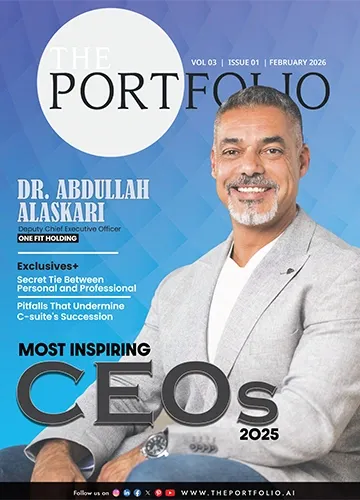
1



Deputy Chief Executive Officer
ONE FIT HOLDING
With over 25 years of experience, Dr. Abdullah Alaskari provides leadership that combines a global outlook in health, wellness, and business. Holding a PhD and having decades of expertise in fitness and lifestyle development, he merges academic knowledge with practical skills to enhance performance and elevate brand influence. As Deputy CEO of ONE FIT HOLDING, he focuses on expansion, fostering community involvement, and creating sustainable value in regional markets.
Industries do not transform because trends appear. They transform because leaders anticipate shifts before they become obvious and build structures strong enough to withstand disruption while remaining agile enough to evolve. In the Middle East’s rapidly maturing fitness landscape, such foresight has become essential, particularly as wellness, performance, and investment converge into a single growth narrative.
Dr. Abdullah Alaskari, Deputy Chief Executive Officer of One Fit Holding, has spent more than two decades operating at that intersection of strategy and execution. With a background spanning corporate finance, investor relations, large-scale business development, and board-level advisory roles, he has consistently positioned himself at the intersection of long-term value and operational precision. From collaborating with global brands such as UFC and Paris Saint-Germain to driving franchising, joint ventures, and restructuring initiatives across the region, his work reflects a disciplined understanding of how fitness must evolve to remain relevant.
Today, as he helps shape the expansion of One Fit Holding across MENA, he continues to focus on scalable growth, disciplined diversification, and sustainable performance. In a conversation with Portfolio Magazine, he reflects on the milestones, lessons, and leadership philosophies that define his journey.
When I look at my journey, what stands out is not a sudden leap into leadership, but a steady layering of experiences that have ultimately led me to where I am today. I graduated from Virginia Commonwealth University in 2000 with a degree in business marketing, and even during my university years, I was already exposed to the pace and discipline of professional life through an internship at an ABC News affiliate in Richmond, Virginia. That internship turned into a two-year role, and there I first understood what it meant to operate in environments where precision, accountability, and timing are everything.
Returning to Kuwait marked a shift from media to finance and corporate strategy. At the Kuwait Fund for Economic Development, I worked as a communications officer for three years, which sharpened my understanding of institutional responsibility and public positioning. I then moved into Gulf Bank as a marketing manager and later into Global Investment House as an Investor Relations Manager, where I was directly responsible for engaging with investors. That role, in particular, deepened my respect for transparency, performance metrics, and long-term credibility. When you represent an organisation to its investors, you quickly learn that trust is built on consistency, not charisma.
Throughout this decade-long corporate journey, however, fitness remained more than a hobby. I continued training clients, consulting, and staying actively involved in the industry. Eventually, I reached a point where passion and professional discipline merged, and in 2010, I opened my first gym in Kuwait. Running that gym for seven years was transformative because entrepreneurship exposes you in ways corporate structures do not. Every decision affects cash flow, culture, and customer loyalty simultaneously. It teaches resilience through experience rather than theory.
In 2015, I was approached by Alarjan, one of Kuwait’s largest real estate developers, to build and integrate a fitness division within their portfolio. That opportunity allowed me to combine corporate structure with industry passion. While working there for seven years, I also pursued and completed my master’s degree in sports management, strengthening the academic foundation behind my practical experience.
Then COVID arrived and disrupted both real estate and fitness globally. Like many executives, we were navigating unprecedented uncertainty without clear answers. Instead of allowing anxiety to dominate, I chose to invest in long-term growth and enrolled in a PhD program. Continuing my academic journey during such instability helped me maintain clarity and focus.
In 2021, a call from Ahmed Al-Sair, who had brought UFC to the Middle East and had previously been my chairman, opened a new chapter. After discussing the regional vision and how I could contribute, I accepted the role. Today, as Deputy CEO for the Middle East, I see my journey not as a series of separate chapters but as cumulative preparation for this responsibility. Receiving my PhD last June was deeply personal because it symbolised perseverance through uncertainty.
“Growth does not pause for uncertainty. If anything, uncertainty demands that we grow faster.”
Each role I have held contributed a specific capability that I rely on today. My marketing background allows me to understand positioning and brand perception beyond surface trends. My experience in finance and investor relations enables me to interpret numbers strategically and engage confidently with financial stakeholders. Because I have operated across departments, I do not see business functions as isolated silos; I see how they influence one another.
However, the most defining lesson has been about empowerment. Earlier in my career, I observed how easily leaders can fall into micromanagement, particularly in high-growth environments. Over time, I realised that scaling an organisation requires trust more than control. When you hire someone for a role, you must allow them to own it fully, including the possibility of making mistakes. Growth does not occur under constant supervision. It happens when responsibility is real.
“If you hire talent and then refuse to trust it, you are limiting both the individual and the organisation.”
Leadership influence often reveals itself through both inspiration and contrast. My father remains my strongest positive influence because his integrity and discipline established a personal benchmark I continue to strive toward. Watching someone lead with quiet strength shapes your internal compass long before you enter professional life.
At the same time, experiences with previous executives who approached leadership differently provided equally important lessons. Observing ineffective styles clarified what I did not want to replicate. In that sense, both positive and negative influences shaped my approach, reinforcing that leadership is as much about character as about authority.
While we continue to manage and expand the UFC business across the Middle East, our strategy has evolved to reflect industry dynamics. Recognising how quickly fitness trends shift, we established a fitness holding company last year and added five new brands to our portfolio, with further expansion planned. Diversification is not optional in a sector driven by rapidly changing consumer preferences.
Geographically, we have moved beyond six GCC countries and Egypt to include Iraq and Jordan, with Lebanon expected to follow. However, expansion without alignment creates operational risk. My priority is to ensure that territory growth, brand acquisition, compliance, and development plans move in sync. Sustainable growth requires disciplined integration, not just rapid footprint expansion.
The global fitness and wellness sector continues to grow at an extraordinary pace, and what excites me most is the convergence happening within it. Fitness is no longer isolated from wellness. Facilities are integrating recovery science, mental health programming, and even clinical wellness components into their ecosystems.
Consumers today are not purchasing access to equipment; they are investing in lifestyle infrastructure. Organisations that understand this integration and build experiences around it will lead the next phase of industry evolution.
A common assumption is that if there is a CEO, a deputy role may be redundant. In reality, our footprint spans multiple countries and brands, and the velocity of growth requires distributed leadership. Responsibilities are strategically divided, and alignment happens continuously. One individual cannot sustainably manage such complexity alone.
UFC Gym introduces diversity that traditional models often lack. While we provide everyday fitness solutions, we also deliver comprehensive mixed martial arts training, including jujitsu, kickboxing, boxing, and wrestling. That breadth changes the consumer experience.
Our youth programs have been particularly impactful. UFC Kids initiatives across the region have shown measurable improvements in discipline, academic performance, and confidence. Many participants now compete at local, regional, and international levels, earning medals and championships.
Modern gyms are evolving into holistic performance hubs. Membership today includes access to fitness, coaching, recovery, and mental well-being, not just a physical training space.
Belief in oneself is foundational. Without it, opportunity feels intimidating rather than energising.
Commitment to continuous self-development is equally critical. Science, information, and business models evolve rapidly, particularly within fitness and health. Returning to school, pursuing specialised courses, and seeking mentors keep leaders relevant.
Finally, example matters more than authority. Employees and colleagues follow behaviour, not titles. When discipline, accountability, and professionalism are modelled consistently, culture strengthens organically.

Thank You For Subscribing
There was an error while trying to send your request. Please try again.