1



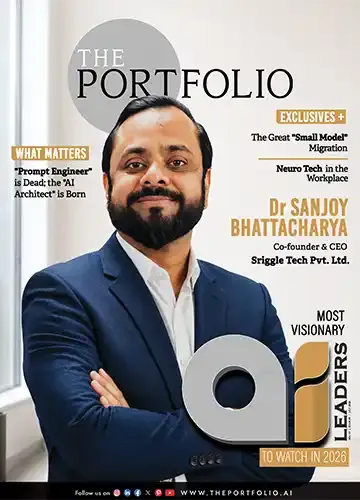
Co-founder & CEO
Sriggle Tech Pvt. Ltd.

Dr. Sanjoy Bhattacharya brings over 20 years leading technology transformation across global enterprises. After working across international travel businesses, he believes technology's purpose is helping businesses gain clarity, decide better, and refocus people on customers over systems.
Businesses rarely struggle because they lack technology. More often, they struggle because every new system promises simplicity while quietly adding another layer of complexity. Information becomes fragmented, processes multiply, and people spend more time navigating software than solving the problems that matter. Growth slows not because organisations stop innovating, but because complexity gradually begins to compete with progress itself.
Very few technology leaders have watched that pattern unfold as closely as Dr. Sanjoy Bhattacharya, whose career has spanned more than two decades, leading technology transformation across global enterprises before co-founding Sriggle Tech Pvt. Ltd. Working across international travel businesses exposed him to businesses that differed widely in size, geography, and business model, yet shared remarkably similar operational challenges. Teams invested enormous effort in connecting disconnected systems, reconciling information across multiple platforms, and managing processes that technology was originally expected to simplify. The longer he worked in the industry, the clearer one conviction became. Travel did not need more software. It needed technology that removed complexity instead of creating it, and that exact philosophy continues to shape Sriggle today. Rather than viewing digital transformation as the adoption of newer tools, he believes its real purpose is to help businesses operate with greater clarity, make better decisions, and give people more time to focus on customers instead of systems. Artificial intelligence may redefine how travel businesses operate over the coming decade, but he believes lasting competitive advantage will still come from something far less fashionable: building organisations that are simple enough for people to do their best work.
In this conversation with The Portfolio Magazine, he shares the experiences, lessons, and leadership principles that continue to shape that belief.
People often assume Sriggle began with a single idea or defining moment, but it was really the result of years of seeing the same challenges appear in different organisations. My career gave me the opportunity to work across global travel businesses, and although their markets were different, many of their operational problems were remarkably similar. Teams were spending enormous amounts of time connecting disconnected systems, reconciling data, and managing manual processes that technology should already have solved.
What stayed with me wasn’t the complexity of travel itself. That complexity is inevitable. It was the amount of energy companies were investing just to keep operations running instead of improving customer experiences or creating something new. Over time, I realised the industry didn’t need another software product. It needed a connected platform that removed unnecessary friction and allowed travel businesses to focus on what they actually do best.
The biggest misconception is believing digital transformation begins with technology. In my experience, technology is usually the easiest part. The real challenge is helping people change the way they work.
I learned that during a large global transformation programme, the technology itself performed exactly as expected, yet adoption varied significantly across regions. Different teams had built successful ways of working over many years, so what looked like standardisation from one perspective sometimes felt like losing flexibility from another. That experience changed my thinking. Successful transformation depends far less on deploying new systems than on building understanding, listening carefully, and involving people throughout the journey.
Technology creates new possibilities, but people determine whether those possibilities become meaningful business outcomes. Once organisations recognise that, transformation stops feeling like a technology project and starts becoming a long-term capability.
Much of today’s conversation focuses on chatbots and customer-facing applications, but I believe the biggest transformation will happen behind the scenes. Travel generates enormous amounts of information every day, from bookings and pricing to supplier relationships, itinerary changes and customer preferences. Until now, much of that complexity has required significant manual effort.
I see AI becoming the intelligence layer that helps travel businesses make faster, better decisions. Rather than simply responding to events, systems will increasingly anticipate disruptions, recommend actions, optimise operations and personalise experiences in real time. That has the potential to fundamentally change how travel organisations operate.
At Sriggle, we’ve always believed AI is only as valuable as the quality of the data behind it. Building connected, reliable data foundations today is what will allow businesses to benefit from intelligent automation tomorrow.
Technology has transformed almost every stage of the travel experience, and AI will accelerate that change even further. Yet travel has never simply been about transactions. It is about trust, expectations, and some of the most important moments in people’s lives.
When everything goes according to plan, technology can deliver remarkable efficiency. The real test comes when plans change unexpectedly. Delayed flights, disrupted itineraries or personal emergencies often require judgement, empathy and reassurance that technology alone cannot provide. Those moments remind us why human expertise continues to matter.
I’ve never seen AI and people as competing with one another. Their strengths are different. Technology should remove repetitive work so experienced professionals can focus on advice, relationships and problem-solving. The future of travel will belong to organisations that combine intelligent systems with genuine human understanding rather than trying to replace one with the other.
“Technology should remove complexity, not create it. When businesses spend less time managing systems, they gain more time to create exceptional customer experiences.”
Leading large technology organisations taught me discipline, long-term thinking, and the importance of execution. There were established processes, experienced teams, and plenty of data to support major decisions. Becoming an entrepreneur was a very different experience. Suddenly, every decision carried far greater uncertainty, and there was rarely enough information to feel completely confident.
One of the biggest changes has been becoming comfortable with ambiguity. Earlier in my career, I believed good decisions came from having complete information. Today, I know that waiting for certainty often means missing the opportunity altogether. Entrepreneurship has taught me to make thoughtful decisions with the information available, remain open to learning, and adjust quickly when circumstances change. That shift has probably influenced my leadership more than anything else because it has made adaptability just as important as planning.
Earlier in my career, I viewed risk as something that needed to be minimised. Working in large global organisations naturally encourages that mindset because stability, governance and consistency are essential when you’re responsible for complex operations. Those lessons remain valuable, but building a company has changed the way I think about uncertainty.
Today, I see risk less as something to avoid and more as something to understand. Innovation rarely happens without stepping into areas where the outcome isn’t completely predictable. The important distinction is recognising the difference between reckless decisions and calculated ones. I’ve realised that some of the biggest opportunities only become visible when you’re willing to move before every answer is available. That perspective has influenced not only how I make decisions, but also how I encourage teams to experiment, learn quickly and continually challenge their own assumptions.
Technology will certainly play an important role, but I don’t think technology alone will determine who succeeds. The organisations that stand out will be the ones that simplify complexity for both their customers and their employees.
Customer expectations continue to evolve remarkably quickly. Travellers increasingly expect personalised experiences, real-time information and seamless service across every interaction. Meeting those expectations requires more than adopting new technologies. It requires organisations to connect data, operations and decision-making in ways that allow people to respond faster and with greater confidence.
At the same time, I believe successful companies will continue investing in human expertise. Technology should remove operational friction, while people focus on creativity, relationships and solving problems that require judgement. The strongest businesses will be those that combine intelligent systems with a genuinely customer-centred culture rather than treating digital transformation as an end in itself.
What continues to motivate me is the opportunity to solve meaningful problems. Throughout my career, I’ve been fortunate to work with travel businesses across different markets, sizes and business models. Although every organisation is unique, I’ve always found it rewarding to help simplify challenges that prevent people from doing their best work.
Starting Sriggle gave me the opportunity to take those years of experience and build something around a belief I’ve held for a long time: technology should help organisations move faster, make better decisions and spend more time creating value rather than managing complexity. That remains the purpose behind everything we do.
The travel industry will continue to evolve, particularly with AI accelerating change, but I believe one thing will remain constant. The greatest opportunities will always belong to organisations that combine innovation with a genuine understanding of people, because lasting transformation is never driven by technology alone.
“The riskiest decision is often waiting until every answer is available.”

Thank You For Subscribing
There was an error while trying to send your request. Please try again.