1



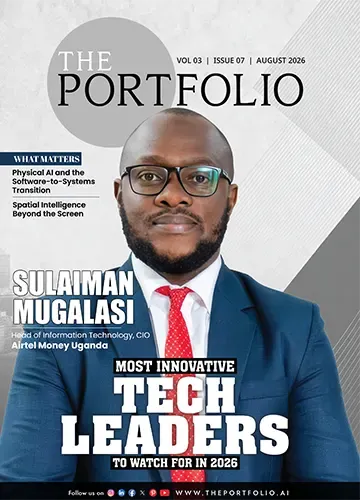
Head of Information Technology, CIO
Airtel Money Uganda

Guiding the telecommunications and fintech sector in Uganda with transformative leadership as Head of Information Technology, CIO, Airtel Money Uganda, Sulaiman Mugalasi shapes the future of connectivity and Mobile Money. Weaving strategic technical execution with innovative digital frameworks, he builds resilient systems that redefine customer experience and accelerate enterprise excellence.
A technology platform is only as innovative as the value people can actually draw from it. Sulaiman Mugalasi seems to have learned this long before taking the CIO seat, beginning his career close to the infrastructure itself, where a network outage was not an abstract technical problem but a disruption someone had to solve, often immediately. Years spent across telecom operations, enterprise IT, banking, digital transformation and fintech gradually changed the nature of those problems. The question became less about keeping systems running and more about how technology could improve how a business serves, grows, and responds to change. Today, as Head of Information Technology, CIO, Airtel Money Uganda, Sulaiman brings that accumulated perspective to millions of customers, billions of transactions and an ecosystem increasingly shaped by digital finance. In this conversation with Portfolio Magazine, he shares what that journey has taught him about making technology genuinely useful.
Technology has changed dramatically over my career, but the biggest shift for me was learning to view it through a business lens. I started with networks, infrastructure, service delivery, applications support and operational excellence, where reliability and keeping systems running were the immediate priorities. Moving into innovation at DFCU and later digital product development at KCB gradually changed the questions I was asking. I moved from asking whether technology could deliver something to asking what business problem we were solving, who it was solving it for and how we would measure the value.
Working on mobile loans, digital banking, biller integrations and fintech partnerships made that shift practical. At DFCU, I established an innovation hub that brought employees, fintechs, and partners together; at KCB, stronger requirements and delivery processes helped reduce the average go-to-market timelines by 60%. Today, as CIO, I see technology as part of the commercial engine, connecting strategy, customers, products and execution.
Digital finance has moved well beyond being an alternative way to transact. It has become part of everyday life for customers, merchants and businesses, which means expectations around reliability have changed as well. A customer sending money to family expects the transaction to work, a merchant needs collections to reconcile and an SME may depend on the platform to keep business moving. Trust, therefore, has to be treated as a business KPI, not simply a technology or cybersecurity KPI.
My own experience reinforced this when we improved platform availability and reduced security threats by greater percentages. Those numbers matter, but accessibility goes further. We have to understand what prevents people from using digital financial services, whether the barrier is pricing, complexity, digital literacy, poor service or unreliable infrastructure. The strongest platforms make people’s lives easier while protecting their money, solving meaningful problems and remaining operationally dependable.
The way people use mobile money is changing quickly. What began primarily as a way to move money is increasingly becoming part of how individuals, merchants, and SMEs manage their financial lives, creating a much bigger opportunity for the industry. My experience working on mobile loans, digital banking, biller integrations and other financial services, showed me that technology alone does not make a product successful. It has to solve a real problem, have sustainable economics and reach the customer effectively.
The next opportunity lies in building a broader digital financial ecosystem around payments, including savings, credit, insurance, collections, international transfers and embedded financial services. Partnerships will become increasingly important because no organisation can build everything itself. In my current role, supporting ecosystem integrations has reinforced my belief that the future belongs to partnerships, not isolated products. The more naturally a platform becomes part of everyday financial life, the greater its value.
Customers don’t really separate technology, security and experience in their minds. They simply expect a transaction to work and their money to be safe, which is why I believe security has to become part of the customer journey rather than something added after a product has been built. Product, technology, fraud, risk, compliance, operations and customer experience teams need to work together from the beginning.
Risk also isn’t identical across every transaction. A routine transaction by a known customer should not necessarily face the same friction as an unusual, high-value transaction. AI, analytics and behavioural monitoring can help us recognise those differences and introduce stronger verification where it is genuinely needed. My experience improving platform availability above 99.9% while reducing security threats reinforced the balance we need to maintain. Security without availability doesn’t create trust, while availability without security cannot be sustained. Customers experience one business, not our internal departments, and everyone shares responsibility for that experience.
Technology leaders today have an opportunity to influence much more than the systems they manage. My own journey from network engineering and operations into banking, digital transformation, product development and executive fintech leadership taught me that every transition requires you to understand something beyond your technical expertise. The more I understood the business, the more effectively I could use technology to create value.
Young technology leaders should therefore develop commercial curiosity. Understand how the company makes money, what drives revenue, how customers are acquired and retained, where costs sit, what risks the organisation carries and what the CEO and Board are trying to achieve. Career growth comes from gradually expanding the problems you can solve, moving from technical challenges to team, operational, customer and eventually strategic ones. End-to-end ownership matters just as much. Customers don’t see our departments or internal structures. They see one company, and technology becomes truly powerful when a leader can connect it to people, products, customers, revenue and the wider business.
“The more I understood the business, the more effectively I could use technology to create value.”




Thank You For Subscribing
There was an error while trying to send your request. Please try again.