

There has been a deeply rooted conception within the organisational system that the finance team deals with money, and the strategy team deals with the world. Treasury watches the accounts, and the CEO watches the horizon.
In 2026, things have completely changed, with the geopolitical early warning system having turned the tables and making the treasury an advanced radar. Whenever there is any sense of a dispute, sanctions, or a trade war, the treasury data shows the foremost sign. According to the PwC Global Treasury Survey of 2026, 94% of multinational corporations have deployed centralised Treasury Management Systems (TMS), while 65% have fully integrated real-time APIs that link global ERPs directly to the banking network. Treasury data has become an advanced operational radar due to structural integration.
The Number on the Treasury Dashboard Speaks Louder
Consider what happened to multinationals with exposure to the Middle East in early 2026. Before the conflict escalated into what BlackRock’s Geopolitical Risk Indicator would later describe as the most significant energy crisis since the 1970s, treasury teams were already seeing it in the data. Cross-border payment delays. Spiking insurance premiums on Red Sea freight corridors. Counterparty banks are quietly increasing collateral requirements on FX forwards.
Cash repatriation slows the moment a country’s political environment begins to deteriorate, well before any public announcement is made. Imminent sanctions prompt correspondent banks to begin tightening quietly. Freight insurance costs spike on dangerous shipping lanes before logistics managers have updated a single route.
The scale of the problem is hard to overstate. A January 2026 survey by Tradeweb ICD found that 88% of corporate treasurers now report moderate-to-high concern about the geopolitical environment, with nearly half citing “high concern,” an 11-point jump from the previous year. When the Middle East conflict escalated in March 2026, that “high concern” figure shot from 48% to 68% in follow-on polling. These aren’t abstract worries. They are balance-sheet worries.
What the CFO Now Actually Does
For decades, the CFO job description was essentially this: protect margins, manage capital, keep the auditors happy. The role carried enormous responsibility but a relatively bounded scope. McKinsey’s late 2025 CFO Pulse Survey, which was published in an article, “How CFOs build resilience against geopolitical uncertainty,” drawing on responses from 152 financial leaders across 22 countries, found that 37% of CFOs now identify geopolitical instability as the single biggest risk to their companies’ growth, with another 32% citing shifts in trade policy.
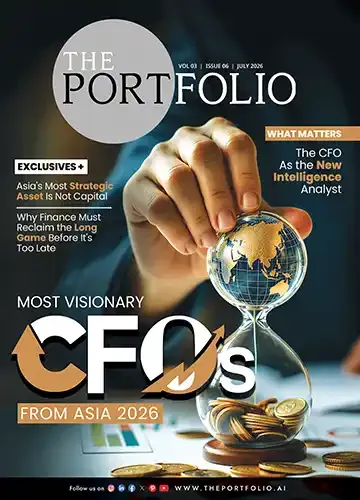
So the idea that finance professionals should just stick to money is no longer in fashion. They are now geopolitical instructors. They sense the geopolitical uncertainty from afar and bring geopolitical stability. Additionally, they are asking which currencies to hedge against in the event of a sanctions announcement. They are, in effect, functioning as the company’s most data-grounded intelligence analyst.
The Intelligence Gap Nobody Is Talking About
The company has immense data, but the real void lies in communicating the threat to the upper hierarchy. Treasury teams sit on signals about supplier payment stress, interbank tightening in specific geographies, and freight cost spikes that, read correctly, would tell a CEO that a market is about to become operationally difficult. Instead, those signals get aggregated into quarterly reports, smoothed into averages, and arrive on executive desks after the moment for action has passed.
To bridge this communication gap and quarterly void, 22% of companies now use AI, according to the Artificial Intelligence Index Report. AI, due to its layered potential, works really fast. Most importantly, it detects the threat in the data much earlier, avoids the quarterly-report loop, and saves the company from uncertainty.
What Companies Need to Rethink
Treasury cannot be a reporting function that feeds into strategy after the fact. It needs a seat at the table where strategy is made, because finance folks aren’t suddenly foreign-policy geniuses; it’s just that money moves way faster than intel reports.
The WEF Global Risks Report 2026 ranked geoeconomic confrontation, interstate conflict, and supply-chain disruption among the top near-term risks facing global business. These aren’t theoretical scenarios. But the operating environment. And the only part of most companies that watches this environment in real time in dollars and euros and hedging spreads is treasury.
The companies that will most successfully navigate the next decade of geopolitical turbulence will be those that stopped treating treasury data as financial housekeeping and began treating it as strategic intelligence.
FAQs:
Q1: Why is treasury data now seen as an early warning system?
Payment delays, rising insurance costs, and tighter collateral requirements often signal geopolitical risk before public news breaks.
Q2: How many CFOs see geopolitical instability as a top risk?
37% of CFOs identify geopolitical instability as their biggest growth risk, with 32% citing shifts in trade policy.
Q3: How are companies using AI to close the intelligence gap?
About 22% of companies now use AI to detect treasury signals faster, avoiding delays caused by traditional quarterly reporting.
Q4: How concerned are corporate treasurers about geopolitics today?
88% report moderate-to-high concern, with high concern jumping sharply after the Middle East conflict escalated in 2026.